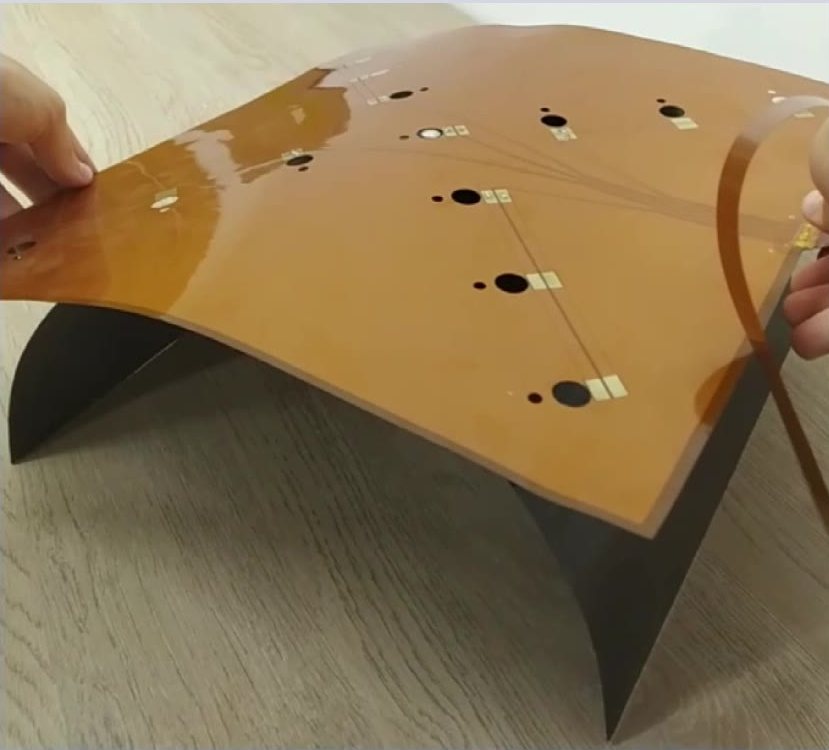
An inspection captures a single moment. Sense&Learn follows the structure throughout its service life.
Ageing critical assets
Wind turbine blades, bridges, hydrogen tanks and aerostructures increasingly remain in service beyond their design life and under more severe loads than planned.
Hidden damage between inspections
In composites, impact damage and the resulting delaminations are often not visible on the surface (BVID). Periodic inspections cannot track their growth.
Costs that never show up in the books
Unplanned downtime, emergency repairs and structures oversized by conservative safety factors.
Apply it, connect it, listen.
At the heart of the patent is a flexible, removable printed circuit with seats for interchangeable piezoelectric transducers, connected to a microcontroller module that processes the signals autonomously.
- 01Flexible-circuit patchConforms to flat and curved surfaces; the sensor arrangement is designed for the component.
- 02Removable PZT transducersFitted into dedicated seats: the network can be reconfigured or repaired without reinstalling the patch.
- 03Processing moduleGenerates the excitation, acquires and processes the signals on board, with no external instrumentation.
- 04Smartphone controlStart measurements and view the damage map over Bluetooth, directly in the field.
From signal to decision in four steps.
The device works in active mode, interrogating the structure on demand, or in passive mode, listening to record events such as impacts.
- 01 — Excitation
Guided waves
One transducer emits a burst of ultrasonic waves that travels through the structure; the others receive the signal in a pitch-catch configuration.
- 02 — Acquisition
On-board processing
The microcontroller acquires and pre-processes the signal of every actuator–receiver path, directly on the device.
- 03 — Diagnosis
Detection and localisation
Damage indices, numerical models and AI/ML algorithms estimate the presence, position and extent of damage.
- 04 — Decision
Condition-based maintenance
The damage map reaches a smartphone or dashboard: intervene where needed, when needed.
More signals, fewer false alarms.
We handle the whole chain: sensor selection and integration, acquisition electronics, data management and visualisation of results. Combining several quantities makes diagnosis more robust under real operating conditions.
Coin-sized piezoelectric transducers excite and receive guided waves that propagate through the material. They detect cracks, delaminations and internal damage, even in complex composite or metallic structures.
Measures strain and temperature profiles along the fibre to identify localised anomalies and load variations. It is the next extension of the patch and the subject of an upcoming patent application.
Inertial sensors and other contextual measurements describe vibrations, dynamic response and transient events, complementing static and quasi-static measurements.
Proprietary data-fusion and diagnostic algorithms, supported by numerical models, are designed to separate the effects of damage from those of temperature and load. Explainable AI methods make the results interpretable for decision-makers.
Built for the field, not just the lab.
Sensor performance matters, but so does how easily it can be installed, used and replicated across a fleet of assets.
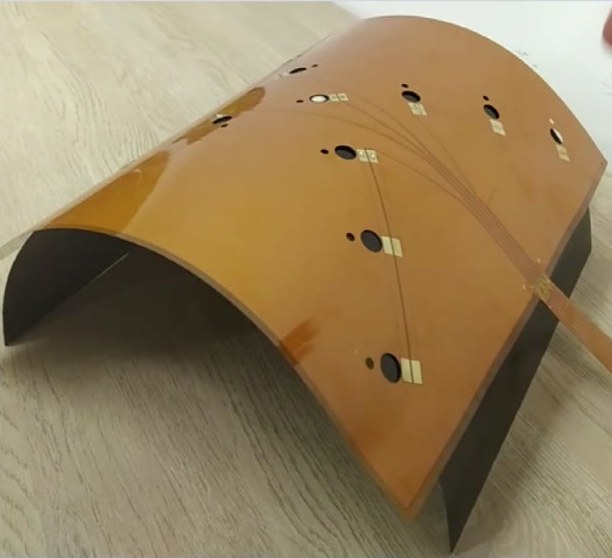
Curved surfaces too
The flexible patch conforms to curved surfaces and stiffened panels.
Minimal wiring
Fast installation, reduced downtime, no cable bundles running to an acquisition rack.
Ready for technicians
On-site tests and immediate results on a smartphone, even in hard-to-reach areas.
From component to fleet
Same platform, repeatable installations, data comparable across assets.
Traceable decisions
Objective reports and indicators for quality, HSE, audits and compliance: every intervention is justified by measured data.
Physics-guided AI
Numerical models and digital twins work alongside machine learning: not just a classification, but an interpretable estimate of the structure’s condition and how it is evolving.
Structural health in your pocket.
The technician starts a measurement over Bluetooth and sees the damage map directly on the phone. Data can feed a dashboard that keeps the asset’s history.
Do you have a structure to monitor?
Tell us about your case: together we will design a pilot with measurable KPIs.